Showing posts with label Bong. Show all posts

Wednesday, 29 March 2017

2 Ingredient Challenge with Makha Shondesh!!

Makha Shondesh/Sandesh is basically a grandma staple from Bengali kitchens that got lost in the race to become modern. It’s an extremely easy recipe, involving just 2 ingredients, and no fuss or elbow grease. I am sure it takes less time than your microwaveable cakes, it contains less calories than those mug cakes and has better nutrition than any pastry or cakes at all. So I bring to you all lovely people, a simple dish, which is as delectable as bongs themselves.


Ingredients

200 Gms paneer or cottage cheese.
2 to 3 Tbsp. of melted date or palm jaggery. In fact a friend pointed out date syrup, and even that works for this.
A mixer grinder
A splash of milk
A pinch of salt.
I bet you already have all these ingredients in home. Just whizz it up and believe me, you would just thank me for it. CHEEERS!!


Saturday, 25 March 2017

10 Minute Cooking- Hilsa with Milk!!


I start today with tradition. If the picture up there seems salavatingly amazing, then you got to try these recipes one after another. Today I bring to you the most integral part of any big Bengali Bhoj (BBB) - ILISH or Hilsa or Indian Shad or Hilsa Herring. This is a great recipe for a relaxed sunday lunch. Very few ingredients in the best part of the dish, followed by the time taken from start to finish is just 10 Minutes. 

Indian Shad, Hilsa or Ilish, Bangladesh’s national fish is a pride for any bong ever born. From the Pride that a Kaku (uncle) feels when he walks past the envious stares of his neighbours and mates, with a big ilish tail peeking through his fish-carrying-bag; to the pride of a Kakima’s(aunty’s) fish filleting skills with a sharp iron cutting device (Boti); its pride all the way!!! And the best of it all has to be, when their young child starts eating the fish, without the fine bones stuck to his throat. I remember when I did that, and till date my dad looks at me with pride in his eyes!! :-P
Enough of jibber-jabber about bongs, now to the fish in question; ‘Ilish’. A perfectly cooked piece of ilish is ideally soft, flaky and full of flavour. I prefer making steamed ilish in a mustard sauce (Ilish Bhanpe) over and over again. In fact I repurposed my introduction to the dish on it. It tastes the best when the fish is freshest. The flavour of this flaky white fish lies in the numerous tiny bones all around its body, which makes eating this fish a skill that bongs have mastered. Ilish is an acquired taste, but trust me, when u do acquire the taste, you wont be able to let it go... 

But now, let's talk of the times when you have those last few pieces lying in the freezer; since a week or 2. That would be the perfect time to make this simple dish. The fresh milk in the stew will keep the fish moist and flavourful all along. It's a pride of a dish, for a pride of the fish!!! Respect it the most tomorrow, because come Monday, and its time for the vegetarian navratra to start. 

Ingredients

Unlike Baking, where the measurement of each component is related to science behind it being made properly, stove-top cooking is much relaxed and based on taste. I am going to provide you with a basic measurement idea, but suit yourself and tailor make this dish based on your and your family's taste buds. 

1 Cup Milk
1 tsp Turmeric
Salt to taste
Green chillies to taste
2 big pinches of Kalonji/Kala Jeera/Nigella Seeds
1 small dry red chilly
2 tbsp of Mustard Oil
4 steak kind pieces of Hilsa, which needs to be marinated in salt and turmeric for minimum of 30 minutes.


 CHEERS!!!


Friday, 27 November 2015

Ilish Begun (Hilsa and eggplants cooked in Mustard)

There are times when every efficient household in every bustling city goes through unimaginable stress. Mine is going through one right now. It is at these times when we stop and realise life is too short to be running all the time. Mornings are too beautiful to be missed. And dinners are too important to be skipped. It’s just the dinner where everyone in the house sits and dines together. Though my mind tells me that it should be a bowl of fresh out of garden salad that I need to dig in, but the heart guides you to a more elaborate carbohydrate filled and rich dinner that brings everyone together on the table. Couple it with a mismanaged household and all the running stress; and, this dish is born. 

I have been working from home since long. And suddenly today when I have to be out of the house each day, every day at the same time, somehow nothing seems to work in my favour. Everyone has expectations too high, and I have tolerance too low; which makes life really miserable for many. Yes my laundry basket is full and overflowing at times and a kitchen which is never clean by my standard. Absence of a proper housekeeper is evident from every corner of my home.  


While I sort through my troubles, I figured it is time for indulging in a dish that has given meaning to a life of a Bong more than once. My freezer has been ignored in these trying times, to the effect that it’s been more than 15 days since these last few pieces of fish were jailed inside. It’s a delicacy for us, on palette as well as on the wallet. I couldn't risk it on the untrained hands of my help to cook it properly. I for sure didn't have time, bouncing from one task to another. Finally, yesterday something dawned on me and i found these few fishes lurking in the dark corners of my freezer. I decided it is time now to come out of the induced slumber of inertia, and make something delicious, yet easy and comforting for my family to savour. My Ilish Begun is easy, sharp and gets the palette interested in the right level at the right time!

Ingredients

Ilish/ Hilsa/ Indian Shad- 6 steak pieces (
2 tbsp whole Yellow mustard seeds
1.5 tsp whole Black mustard seeds
1 dry red chilly whole, cut into 2 pieces
½ tsp of nigella seeds
½ tsp or less of ginger paste (just a pinch)
5 tbsp of mustard oil
2 long brinjals (small size) cut into 1 inch pieces
Salt to taste
Sugar to taste
Turmeric powder to taste
8 green chillies slit

Method


Smear the fish well with salt and turmeric to marinade, and keep it aside.

Marinade the eggplant pieces in salt, sugar and turmeric and keep it slanted on the kitchen counter for 20 minutes. 

Make a paste of both types of mustard with a pinch of salt and 2 green chillies. Once ground to the desired consistency, keep it aside. 

Now in a pan, heat 2 tbsp of oil with red chilli, and wait till it heats up while the chilly turns dark brown. Tip in the marinated eggplants and fry till it turns golden brown. Take it off the flame and keep it aside. 

In the same pan, heat 2 more tbsp of oil to smoking. Lightly fry the fish pieces and keep it aside. 

Now in the pan add the last bit of oil and crackle the nigella seeds. Tip in the mustard paste, and fry for 30 seconds. Add salt and turmeric to taste, followed with a half cup of water. 

Once the paste starts bubbling add in the eggplants and give everything a good toss. Add another half cup water, and let it come to a steady simmer. 

Tip in the fish pieces and adjust the water the way you wish it to remain. Let everything simmer on low heat, partially covered for 2 - 3 minutes. 

Taste for seasoning, and switch off the gas once you are certain of it. An additional drizzle of cold pressed Mustard oil will bring up the flavour and taste many folds. Serve it hot with steamed rice. 


P.S.- I had left over pieces which included the head and the tail of the fish as well. These cuts are extremely delicious and I am quite against of throwing these away. Respect your food and keep the wastages to minimum. Cheers!!

Monday, 5 October 2015

#DurgaPuja2015

Ya devi sarbabhuteshshu,
SAKTI rupena sanksthita
Namasteshwai Namasteshwai Namasteshwai
Namo Namaha

Very very soon, the radio is gonna go abuzz with these heavy words from an even heavier throat. That time of the year is here. The new clothes smell so good, so fresh and so pretty. We as a community are gearing up to welcome Ma Durga to come visit us for 5 days. Festivities would start. There will be songs and dances. There will be drama enactments. There will be a lot of nice things to eat. There will not be calorie consciousness. There will be 5 days of no flame in every bong household. This is pujo as we know. This is the pujo that we yearn for all year round.


A typical day during the pujo starts with Uposh/vrat/fast. We get up, bathe, don new day wear and off to the pandal to offer our prayers with utmost sincerity. Then comes pushpanjali. After the general prayer of wellbeing, we offer our deity fragrant flower and three leaves of wood apple tree, in hope that she blesses and accepts our prayers. Sheesh, even in prayers we offer bribes. But it’s a bribe that gives the nature a push to make it more beautiful. These plucked flowers and leaves, ensure that the tree produces more fragrance and more colour around us.

After pujo, the breakfast commences. Every pandal would host a couple of street food stalls from where, depending on the taste and temperament, we choose our breakfast. For me, my heart just desires a good plate of fresh puffy Radhaballabi with alur torkari (deep fried lentil stuffed flat breads with potato curry) or korai shutir kachori with alur torkari (deep fried green pea stuffed flat breads with potato curry). These fresh treats are really something of indulgence, but this is festive time, and it calls for indulgence. I did forget to mention that before breakfast, a simple proshad of fresh cut fruits which were offered to the deity, is passed around as well.

Pujo without mishti is pretty much unfathomable. And a mid-morning snack has to be a delectable plate of soft rasogulla or deep fried and dunked in sweet syrup kind khoja! Yes I know, oil is directly proportional to pujo, and you really can’t differentiate the 2 for these 5 days. If you fear about your arteries, it is now that you should start intense work out and eat salad between all the planning.

The lunch is just the bhog. That divine intervention in making that simple khichri just takes the dish to a new level of taste. Also its fun and frolic, you stand in a line with your friends, talking and chatting, while flaunting your beautiful day wear saree; that in itself is enough to notch up the taste parameters of a khichri which is made in bulk and served to everyone who comes in.

After lunch, it’s time to head home. The evening needs to be prepared for. The new night wear saree comes out. Home facials are done. Make up is selected. And off we go again in the finest of our glory. Everyone in the pandal would look party ready. It’s a beautiful place to be. The programmes start. The stalls light up. Friends catch up to a dinner of fish fry or Frankie’s with loads of cold drinks flowing about.

This is my fondest memory of pujo. All my life we have done this. And for the further years, we will continue to do this. Pujo is a celebration. A festival where we celebrate each of the five days. And today, we would love to tell you about it. A group of 4 bloggers have come together to make u feel at home in the festivities. 2 are coming straight from the heart of all merry festivities in Kolkata. I am trying to explore pujo in a new city- Gurgaon. And another blogger is coming all the way from Australia. We have planned many wonderful things for the coming days. So keep checking and keep clicking!! Cheers!! :) 


Monday, 24 August 2015

Turning 30 With Kochur Loti (Colocasia Stems)

Is age just a number? Or does it signify something… For sure I am getting older! This year I would be celebrating my big 3 with a child who is a big 2. I don’t know if it’s the number, but I surely think it’s a bigger issue here. I chose to settle in matrimony at an early age, and as a result, my life took a fast turn into a calm sunset. Lots of my friends are still living off tinned, packaged food, while I make gourmet domesticated stuff that I grow in my garden. Flirting with fenugreek and spinach is all I do to perk up a boring week evening. And nothing can lift my mood up and beyond than a simple glass of chilled iced scotch coupled with jazz in my ears. Really, I am still in my 20-ies. But these are the things I work hard for, the good luxuries of life.

Why do you think I am ranting about age today? Well, it stemmed out of nowhere literally, but when it did, I was completely flummoxed and out of words. It all started on a fateful evening. I decided to drop in unannounced on a friend who was a birthday girl that day. In the morning when I called to wish her, I heard her recount all amazing plans for the weekend and the birthday; and I severely felt left out as I didn’t fare in any of the plans she recounted out to me. So, after my busy day in the kitchen, I picked up my little guy from school and barged in to her apartment. There I met a girl for the very first time- Miss X. I casually told her my name and she brightened up to tell me that ‘I have heard so much about you, so good to finally meet you.’ Here was Miss X, of whose existence I had no idea at all; though she regularly featured in my friends various parties and get-togethers. But she knew me by my name and I didn’t. That got me thinking, why it is that such a good friend of mine never involved me in her plans, but talked about me to everyone she met. She is still single, has a happening life in the metro. She can go to Agra at a moment’s notice. Somehow I don’t have that luxury anymore. I have matured into a place where I plan each day in the morning, and follow it immaculately all throughout. I cook, I write, I garden, I work and then I drink my favourite and off to sleep to wake up to this very routine again. Boring is it? Don’t know! Am I too busy to notice? Don’t know again! Am I enjoying this? Well, in a very strange fashion, yes I am.
I am enjoying being in this routine. We do party, but our parties don’t have night clubs or discos anymore. And somehow, we have grown to like such a quiet elegant life. Merits are plenty too.  We eat healthy each day, and so eating out or ordering in is special and is done to make memories. We spend our days thinking about designs of new furniture or some other thing like a new dish or a new crop to grow. And my little guy, he is in the centre of it all. We have grown old. And it’s good to agree, feel and act like your mental age. After all, I conclude- Age is just a number!

Today’s recipe is nothing else. It’s an ode to mature tastes. As a child everyone hates colocasia. It’s an acquired taste, just like whiskey. A matured palette can differentiate the finer nuances of the taste. The itching fades away as our throat becomes bolder to fathom more calcium oxalate than before. Today I made this dish to be served in a potluck. I packed it in colourful dabbas, and the picture is testimony to that. But really, the dish can’t get simpler than that. Now, I created this curry with colocasia stems, but you can easily substitute it with cauliflower, following exactly the same steps as shown below.

Ingredients
500 gms Colocasia stems, washed peeled and cut in 2 inch size pcs
To be ground to a fine paste
·         2 tbsp of black mustard seeds
·         1.5 tbsp poppy seeds
·         Green chillies to taste
·         Pinch of salt
·         Very little water
P.S. I don’t strain the paste to remove the black shells of the mustard. You can if you so wish to. The old kakimas (aunties) always blamed the shorshe shells for their husband’s poor tummy. Though I feel otherwise, and blame the mustard oil instead.
2 to 3 tbsp of mustard oil (I know it’s quite less, but if you use this efficiently it will give you amazing results)
A pinch of ginger paste (to enhance the mustard flavour)
1 tsp of onion seeds/ nigella seeds
Water as per requirement
Salt, sugar and turmeric as per taste.

Method

Wash and drain the stems well and in a steaming pot, steam it in a microwave/steamer with some water. Steam on high power for 5 minutes. Let cool, strain and discard the water which would now be filled with calcium oxalate- the culprit that causes the itching. Let the stems drain out completely and come back to room temperature.

Once it’s cold to touch, smear on the mustard and poppy seed paste evenly. Mix in the ginger, salt, turmeric and a tbsp. of oil. Marinade in it for 30 minutes or so.

In a non-stick wok, heat a tbsp. of mustard oil till smoking hot. Splutter in the onion seeds and tip over the marinated stems.

Cook it on low to medium flame, stirring it occasionally till its soft and cooked through. This will take about 15 to 20 minutes. To aid it to cook faster, partially cover the wok with a lid, but make sure to toss every now and then to incorporate air. This will help in uniform cooking.

Salt it generously as it would be served dry with steamed rice. As an optional step, do balance the taste and pungency by adding some sugar and mixing it well in the dish. Just 2 big pinches of sugar would do the trick.  
Once you are happy with the texture and taste, switch off the gas and drizzle on a tbsp. or more of raw mustard oil. This is optional, but highly recommended as it takes the dish up to a new height where no one will understand wat exactly hit them. Serve piping hot with steamed rice.


Cheers!

Tuesday, 2 June 2015

Mango-Fish curry, My way!!

My father in law hails from a simple house nestled in outskirts of Kolkata. His growing years were filled with rustic food made in old fashioned coal stove. My grandma in law had 8 kids in total, so that meant a full day in kitchen. She was a wonderful cook and believed in systematic cooking. She made 2 kinds of chapatti dough, one with ghee and salt to be eaten with vegetables in the tiffin. And one without anything added, to be had with milk and jaggery as a porridge. If you ask me, that was quite some dedication, which got lost in the next generation itself. This is how evolution happens. My mother in law never bothered to make separate dough and in fact, any chapatti which gets left behind in the dinner is had as a porridge next day. The system has evolved, and will keep doing so every time a new person is added to the family. In my house, I rather have porridge made with oats. And so there is really no scene of chapatti in milk.

This is how rustic food has evolved much to suit the requirements of today. In my house, I am constantly seeking and developing recipes from old times. My grandmothers in law are my biggest inspirations from where I get many ideas about how a dish should be made, the old school way. I don’t want that rich cuisine to die as well. I mean trust me, I am going to make ‘Tel Koi’ the old way with tomato juice and ginger juice rather than paste. It’s a celebratory dish, which has very important stand in our culture. It will be made and served with élan. But normal everyday food doesn’t have to be such a rich thing. A simple easy curry is all I seek when I get a friend over for dinner. I have used Indian Carp to make it, but any fish can be used for this dish. It’s a perfect summertime treat for non bongs too, as it has a nice tangy flavour to it.
This dish is best served with a light carbohydrate like rice. But I have given it a slightly healthier outlook by substituting rice with bulgur wheat. I feel, it’s the perfect carb to go with this light preparation. But you are the king/queen of your pallete. Whatever suits you, make that!
Ingredients-
  • 6 steak size pieces of Fish on bones (river water or sea water, both would work)
  • 3 pcs of raw mango nuts with a little pulp on it (I used the pulp of these mangoes to make a separate chutney. The seed that was left behind was used for the dish- minimal wastage is the basis of a successfully functional home)
  • ½ tsp of onion seeds/nigella seeds/kala jeera
  • 1 dry red chilly
  • 3-4 tbsp of mustard oil
  • ½ tsp of turmeric powder
  • 1 inch of ginger root grated
  • A lot of water
  • Salt to taste
  • 1 tbsp of whole-wheat flour
  • 3 slit green chillies
  • A big pinch of coriander leaves chopped
  • 2 potatoes quartered (optional)
To know how to make this incredibly easy and delectable rustic curry, click on SmartIndianWoman.com

Monday, 13 April 2015

Poila Boishak Special

Come Wednesday, and the full Bengal would be in a festive spirit. It’s Poila Boishak- the Bengali New Year, right in the middle of a week. But Kolkata doesn’t care. It becomes just like getting 2 weekends in a week…
I urge all who read this to try at least one thing bong this Wednesday. I have compiled a list of easy recipes, that’s taken from the heart and soul of my kitchen. I make these recipes very often, and that’s why they are completely full/foolproof.

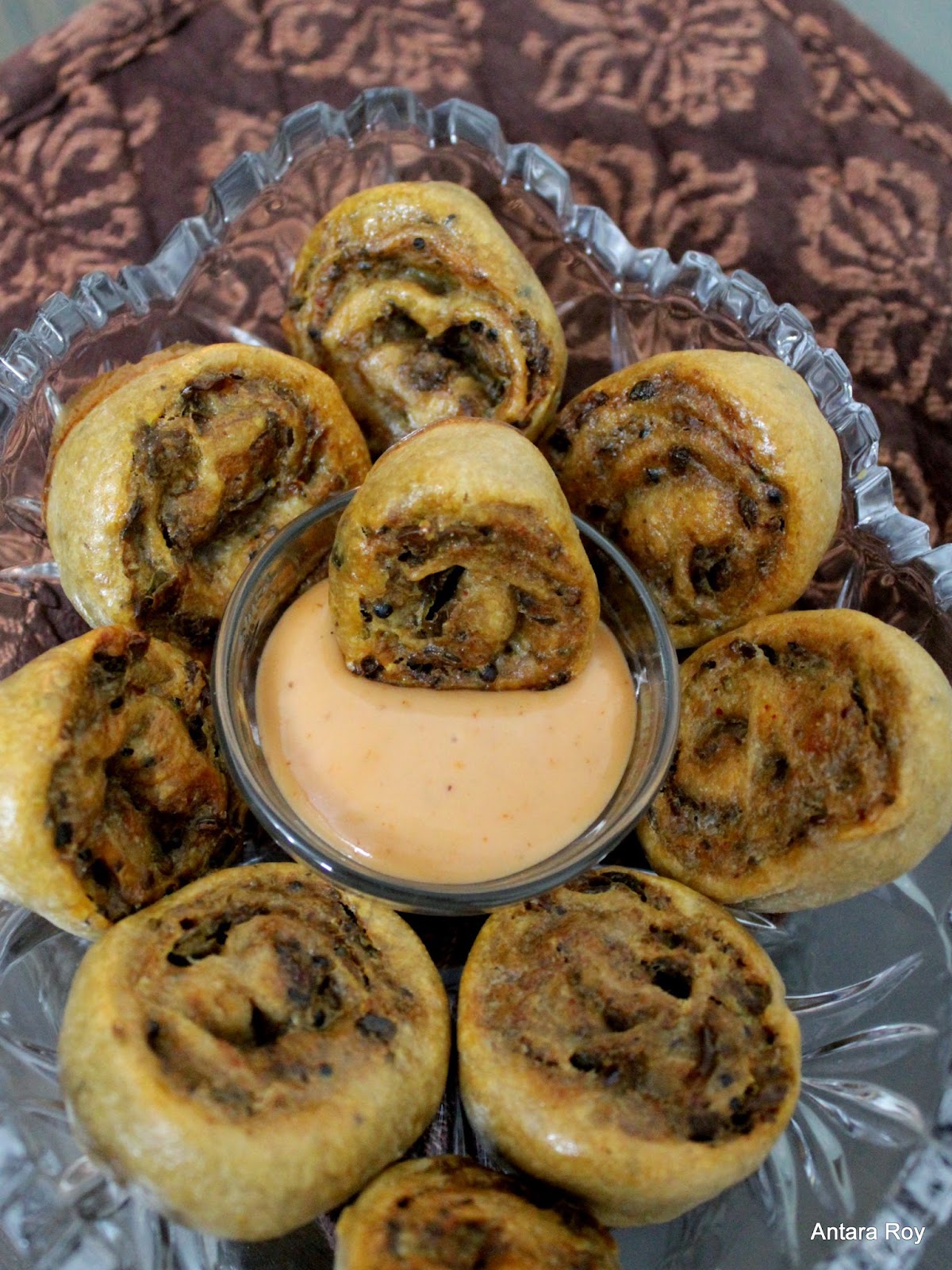
To start with, try this yum inspired Matarshuti Kachori (Pea filled flat-breads), my way. I have given it a spin by making it in pinwheels and baking it to crispy perfection, instead of the traditional frying. This serves as a wonderful appetizer, any day of the week.


For main course, go the veg way by making Kumro Chokka (a dry version of pumpkin curry). This pairs well with rice, Roti, and / or paratha


Or take the paneer route by making my famous Paneer Dalna (paneer curry) with no onion or garlic. Simple yet clean flavours.

If fish is in your mind, then try these super easy recipe of Daab Chingri (Prawns cooked in a tender coconut). If you can’t source these tender coconuts then do the same recipe in a glass dish and stick it in a steamer or a microwave. I prefer to steam my fishes, which to me tastes much better. 

R

Ilish, or hilsa need no introduction. The flavour just transcends it into a hero of the dinner at a go.


But if its eggs that you like, then Dim Kosha is the way forward. You can use duck eggs or simple hen eggs, but the curry never fails me.


For a quick dessert fix, try my easy peasy Pithe Payesh inspired Coconutty Goodness. Pithe Payesh is a bong homemade dessert where a porridge is made with milk, but no rice. In this recipe I have used semolina and coconut. This is easy to put together and can be made a day in advance for a party as well.


After such a big Bong dose of yummy food ideas, I am sure you are inspired enough to throw a full-fledged bong party soon. Cheers!!

Thursday, 9 April 2015

Veggie Bong Spl - Kumro Chokka

Celebrating the Bengali Legacy dishes with my twists this week- Poila Boishak Special....

Let me start today with a story. A story that the young me got really shocked to star in. Once upon a time, a big while ago; I met my man of dreams and together we went to seek a flat in the busy metropolitan Mumbai. Our offices were in Lower Parel, the southern neighbourhood of commercialised mill properties. It started as a humble neighbourhood, which fast became the most expensive part of the city. To us, it made sense to stay near our offices better than travelling in the maddening traffic up and back everyday. There were these humble 1 bedroom flats up on rent, a very basic setup but for a young love struck couple like us, it seemed perfect by many statures. The meeting with the landlady started with a question; “what is your caste?” The answer put a smile on her face. “Oh good, you are a Brahmin, our flat would be blessed. I am extremely happy to have you here, especially because we are also vegetarians.” I was perplexed. “Vegetarians?” I asked. She stared back blankly, “you are Brahmin na… then?” “Yeah, but we are Bengali Brahmins, we eat non vegetarian food as well. Is that a problem?” my husband asked. It took a minute for the landlady to overcome the shock. She calculated the copious amount of rent that we were about to pay her and then mumbled out, “yeah OK, the sin is for you to bear!”

I had met many such vegetarian Indians who have cringed upon us for being Bong Brahmins. Yes, the elite caste in every region apart from the eastern, comes with a preconceived cuisine of vegetarian delicacies. Nothing wrong in that I say, but the nose cringing and talk of sins is wrong. Wrong if you think so, and wrong if you feel we are lesser Brahmins than you. Every region comes with its history. Try to understand it and you would know exactly why we don't follow what you might. Bengal is prone to floods every year. Do you think it was a better idea for the whole sect to die hungry, rather than eat what was available to us at the difficult times? And yes, after that we chose to continue eating, respecting every single morsel of it.

A lot of our food revolve around fish, and it’s true. But another fact that is as truer is that we eat a lot of veggies too, some really exotic and exclusive to our region. A typical bong thali looks a bit like this- It starts with bitter vegetables, transcends into a leafy vegetable- Saag and then does it give way to the non-vegetarian fare. And I remember growing up like this. We ate a hearty amount of saag and veggies, and 1 pc of fish daily.

Today, I am going to write about 1 of the most classic vegetarian dishes that the Petuk Probashi Bangal me loves to eat quite often than not. It’s rather easy to put together, and respects the vegetable enough to keep its flavour clean. This is how I like to make it, my way.

Ingredients

200 gms Pumpkin, diced
1 medium sized potato, diced
2 tbsp mustard oil
1 whole red chilly
1 bay leaf
½ tsp Bengali 5 spices (Panch Phoron- a proportional mix of cumin seeds, nigella seeds, fenugreek seeds, fennel seeds and black mustard seeds)
Salt and turmeric to taste
A pinch of asafoetida (hing)
1 tbsp + ¼ th cup water
1/4th tsp sugar
1 tsp cumin powder (jeera)
2 tsp coriander powder (dhaniya)

Optional
A big pinch of coriander leaf chopped to garnish

Method

Dab dry the diced vegetables and keep it aside.

Heat 2 tbsp. of mustard oil in a non-stick wok, till its smoking point. Add the dry red chili and let it burn until its black in colour, quite literally so. Trust me, the smokiness of this burnt chilly will impart such a contrasting flavour to the dish that you would most certainly be bowled over.

Once there, add the Bengali five spices and bay leaf to the oil and let splutter. Add the potatoes at this stage and let it sauté in the oil till it develops a golden hue all around. Now dump in the pumpkin along with a big pinch of turmeric and cook on medium flame uncovered to develop a beautiful colour all around. It’s important that the pumpkin is not covered or salted at this stage. We need to caramelise both the veggies well, taking utmost care to stir every once in a while.

Once its nicely golden and 50% cooked through, salt it to taste.

Dissolve the pinch of hing in a tbsp of water and add it to the hot pan. This is a unique step, but believe me it adds to the dish pretty well. Thoroughly mix it with the vegetables and cook for a minute till the aroma of hing wafts off.

At this stage dump in more water, stir and let it simmer on low flame till you prep the 3rd unique step in the recipe- roasting dhaniya and jeera powder.

In a hot pan or tawa, dry roast freshly ground cumin and coriander seeds. Let them colour well, taking utmost care to not burn the delicate masala. Transfer it out of the tawa as soon as you feel the aroma pulsing through the kitchen, and set it aside.

Once your pumpkin is almost cooked through, dump in the masala and give it a good stir. It’s imperative that till this stage there is a bit of water in the pan which will cook down the roasted masala a bit. Otherwise, the masala would actually turn crunchy, and would mar the dish with too much of uncooked strong flavour. Once there, put the flame on high and while stirring constantly, let the water dry out.  Taste, season and serve it hot out of pan with steamed rice and an easy lentil curry.

Cheers!!

Wednesday, 8 October 2014

My Fish Head Biryani- Muri-Ghonto!!

Today I wrote a 1-picture post, as I don’t know how to beautify this wonderfully tasty fish and rice dish for a picture. It’s no secret that I am a rustic food lover and photographer, and care absolutely no damn for props to beautify a dish. This post is an ode to my belief, and hence I restrict myself to just one, but a real picture of how this special dish should look and be served.

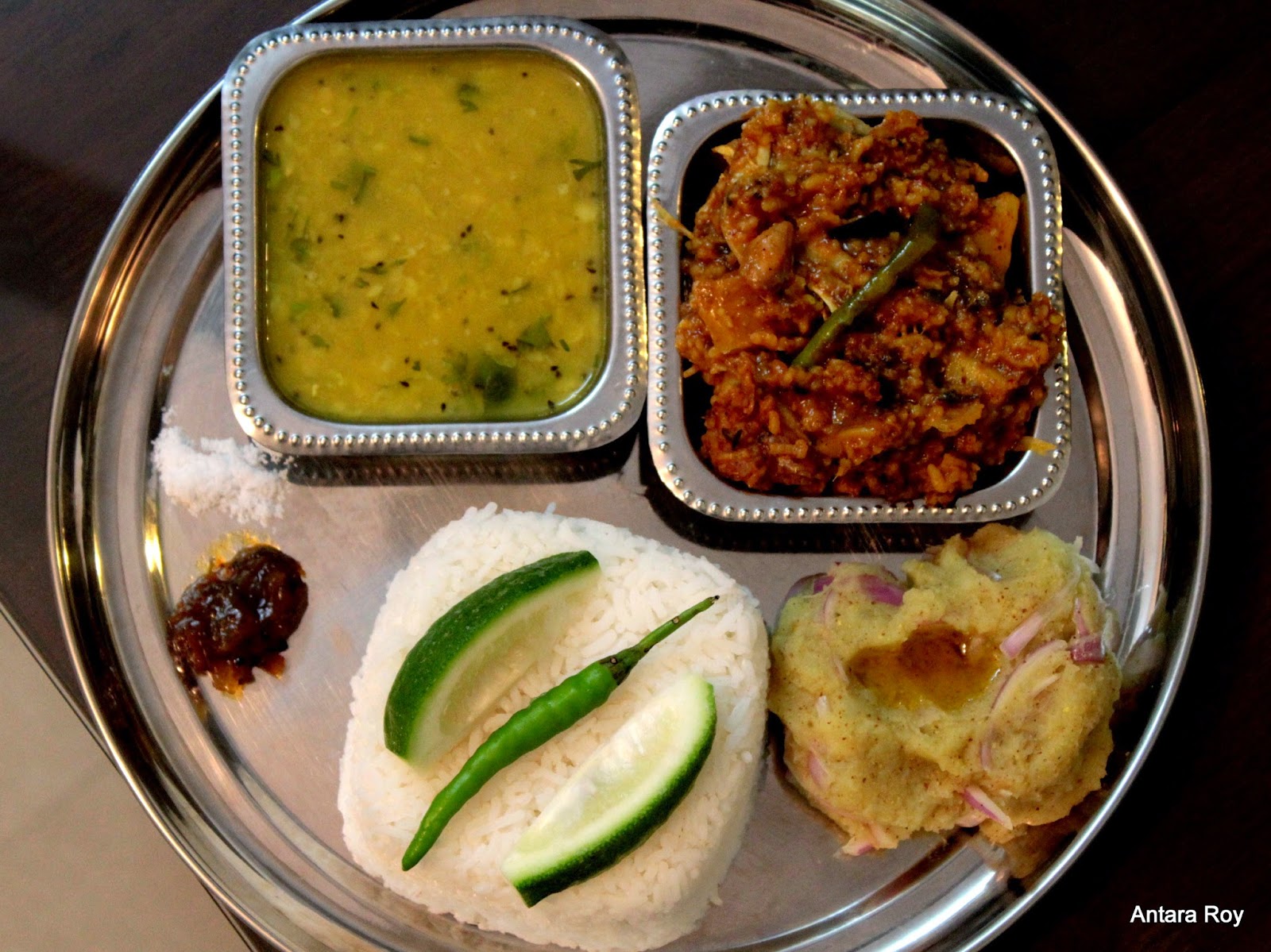
Muri-Ghanto on the right served here with plain dal and mishti alu sheddo (boiled sweet potatoes, onion slices spiced with mustard oil and seasoned).
But that’s not all, I have many more believes that I wanna count on, in this post. Wastage being one of the primary ones, I would want to know out of curiosity; what do u do with fish heads? Before Masterchef Australia glorified this rustic cut, what did you do with it? Discard it? Or just about make a stock with it? Or cooked it, to be left on the plate uneaten? This ancient cut somehow always meets this fate in this cosmopolitan era of eating-what-appeals-to-the-eye concept. But we bongs are pagan enough to love our fish quite that much to not waste out any edible part. And the tasty fish heads are a priced component of our food. We make a dhansak styled dal with fish heads, or make mixed vegetable styled chchori. But my most favourite way to use these little nuggets of deliciousness is to make Muri-Ghanto; which can be loosely translated into a fish head biryani. This messy curry-rice is a one pot meal, with the right amount of spicyness and flavour! For me, it deems the position of being the showstopper dish on the table very easily, and I love to serve it to my experimental guests too.

Now, it’s a no onion and garlic recipe, like many other Bengali dishes. Bengal doesn’t grow 
onions or garlic, and hence it’s hardly used in any authentic curries from our region. So we derive flavour from rather unusual ingredients and spices. Today’s dish uses 1 such ingredient, Gobindo Bhog Chal, a specific rice variety. These small kernels of rice pack quite a punch when it comes to flavour, and we use this variety of rice in everything ranging from baby food to the holy meal- Bhog. Though this is one of the most important ingredients of the dish, it’s not available quite easily awy from bengal. And hence, it can be substituted with basmati rice, but the flavour of the dish will vary.
Gobindo Bhog Chal
Ingredients

Head of an Indian Carp- Rohu
Salt and turmeric to taste
2 tbsp Mustard oil
¼ tsp whole cumin
2 dried bay leaves
2 dried red chillies
½ an inch long cinnamon stick
½ cup fresh tomato puree
1 tsp ground cumin
2 tsp ground coriander
½ tsp cinnamon
½ tsp red chilly powder
1 potato cubed
½ tsp grated ginger
2 fistful of Washed and soaked gobindo bhog rice
Water
½ tsp ghee (optional)

Method

Wash and dry the fish head well. Then coat it with salt and turmeric to marinate for an hour. You can even leave it overnight or stash the fish head smeared in turmeric in the freezer to be had few days later. Turmeric is a great thing to add to marinades, due to its antiseptic properties.

Heat a tbsp. of mustard oil in a non-stick pan. Upon smoking, add the head pieces and fry on medium heat till it changes colour to deep brown all over. Keep it aside once done.

In the remaining oil, add the cubed potatoes and fry till golden. The non stick pan should not ask for more oil, but if need be, do add some to ensure unbroken chunks of potatoes. Once done, keep it aside.

Heat the remaining 1 tbsp of oil, add the whole spices- whole cumin, cinnamon, red chillies and bay leaf to temper. Once aromatic, add the tomato paste mixed with the dry spice powders of turmeric, red chilly, cumin and coriander; and cook till it is fragrant and leaves out oil from the masala mix.

Now add the rice and fry it in the masala for a few minutes. The rice should turn a glorious golden, and start being quite fragrant. Once there, tip in the potatoes, and after a quick mix in the masala, add the fish heads. Sauté all the flavourful elements in the wok well, till the pieces are well coated in the masala mix.

Add water to the wok, till everything is submerged in the water, and still an inch more. The rice and potatoes will cook and soak up the water. Salt the dish well now, and let it simmer covered till the rice is cooked.

Traditionally, this dish is made a tag bit runny and eaten mixed with rice. If you want to do that, then salt the dish generously.

Once the water comes to your desired consistency, and the rice is cooked well, grate the ginger on top and sprinkle on cinnamon powder. Mix well and let the ginger cook down for 2 minutes. Before removing from heat, splash the ghee and stir well. Its best eaten fresh, but keeps very well frozen or refrigerated in an airtight container.  
Muri-Ghanto on the right served here with plain dal and mishti alu sheddo (boiled sweet potatoes, onion slices spiced with mustard oil and seasoned).
Cheers!!

Monday, 1 September 2014

A Weekend Trail thru Food!!

I hate Mondays, and hate it even more when it comes after a very long weekend as the last. What a lazy monsoon type weekend it was, where I just played with my toddler, made good food, ate good food (thanks to the festivities around) and actually got confident to share my interpretation of sambhar with my ever so generous and sambhar expert, my neighbour-Aunty! It was a lazy-lazy time, where I didn’t log into my computer or any of my social media, or stepped out of my building compound.  

Friday started with a Ganesh Chaturthi bonanza. So many social visits, different idols of Ganesh and yummy Prasad to eat. That summed it all.

Tuesday, 15 July 2014

Toddler Steps: An Indian's Guide to Toddler Food

TODDLER ALERT!! I have one right now on my feet, trying to chew my clothes. They are such adorable little creatures. Walking around the house like a drunk penguin, smiling and uttering words in alien languages. They just make a working day go by in a breeze, with half the work done, but keeping you doubly tired at that. I sometimes wonder, what the secret behind their energy is. A HEALTHY DIET goes a long way in keeping them active and gaining weight at that. And more so for us in India, where we are blessed with fresh fruits and vegetables, much lesser in price than their tinned varieties.

LinkWithin

Related Posts Plugin for WordPress, Blogger...